Testosterone Propionate Injections: a pharmacological reference
Testosterone Propionate is a fast-acting, short-chain esterified variant of the parent testosterone molecule. Featuring a 3-carbon propionic acid ester moiety at carbon-17, it provides rapid biological clearance and acute bioavailability, achieving peak physiological saturation within hours of administration.
Chemistry and classification
Because of its short duration of action, it is highly favored by competitive athletes, bodybuilders, and sports professionals during pre-competition drying phases where prompt systemic hormonal clearance and minimal subcutaneous water retention are critical.
The compound offers exceptional flexibility, permitting rapid protocol adjustments or immediate cessation in the event of adverse symptom manifestation, clearing systemic circulation within days compared to weeks for prolonged enanthate or decanoate preparations.
Clinical history
Synthesized in 1936 by pioneering chemists Karl Miescher and colleagues at Ciba in Switzerland, Testosterone Propionate was the first commercially available esterified androgen in medical history, revolutionizing endocrinology.
Throughout the 1940s and 1950s, it served as the medical cornerstone for treating severe male hypogonadism, severe trauma recovery, and female breast cancer prior to the invention of longer-acting depots.
Its rapid pharmacokinetic clearance established it as a staple within Olympic strength sports and elite bodybuilding during the pre-drug-testing and modern tested athletic eras alike.
Mechanism of action
Upon intramuscular injection, the propionate ester is rapidly hydrolyzed by tissue esterases, releasing free unesterified testosterone directly into the capillary beds. The rapid elevation in free and albumin-bound testosterone stimulates acute cellular transcription.
The molecular mechanism mirrors endogenous testosterone: selective binding to cytosolic Androgen Receptors, nuclear translocation, and genomic interaction with Androgen Response Elements (AREs) to dramatically upregulate messenger RNA (mRNA) responsible for contractile actin and myosin filament synthesis.
Due to the rapid pulse nature of propionate kinetics, neural drive, central nervous system excitability, and acute muscular force generation are noticeably stimulated, contributing to significant strength gains even while maintaining strict caloric deficits.

Pharmacokinetics
Testosterone Propionate exhibits a biological elimination half-life of approximately 19 to 36 hours (0.8 to 1.5 days). Peak plasma concentrations (Cmax) are documented within 12 to 18 hours post-injection.
To maintain stable physiological serum concentrations without turbulent hormonal fluctuations, administration must occur on an alternate-day (every other day) or daily schedule. Infrequent dosing results in steep hormone declines that elevate aromatase sensitivity and subjective mood fluctuations.
Metabolized rapidly via hepatic phase I reduction (CYP3A4, 5-alpha reductase, aromatase) and phase II glucuronidation, metabolites are cleared completely through the urinary system within 2 to 3 weeks following cessation.
Use in sport
In sports performance protocols, Testosterone Propionate is primarily chosen during pre-contest cutting, explosive power preparation, and sprint conditioning. The reduced propensity for interstitial fluid retention allows athletes to preserve razor-sharp muscular striations.
It frequently serves as the androgenic anchor when paired with non-aromatizing finishing compounds such as Drostanolone (Masteron), Stanozolol (Winstrol), or Trenbolone Acetate during the final 6 to 8 weeks before athletic competition.
For athletes subject to targeted drug testing with biological passport monitoring, the shorter detection window of propionate (~2 to 3 weeks) provides a distinct pharmacological clearance profile compared to long depots.
Bloodwork and monitoring
Due to rapid pharmacokinetic fluctuations, blood testing for Testosterone Propionate should be standardized precisely relative to the injection timing (ideally in the morning at the trough period immediately preceding the next scheduled dose).
Standard panel tracking includes Total & Free Testosterone, High-Sensitivity Estradiol, Complete Blood Count (Hematocrit / Hemoglobin), Lipid Fractionation (HDL, LDL), and Renal & Hepatic profiles.
Mid-cycle adjustments of anti-estrogenic ancillaries should be calibrated based on confirmed serum estradiol rather than subjective symptoms.
Reference Protocol
For complete reference ranges, marker intervals, and clinical harm reduction steps, see our documentation:
First Steroid Cycle Guide for Beginners: Protocols, Bloodwork & Safety →Adverse effects and harm reduction
Aromatase-mediated conversion to estradiol occurs rapidly following propionate peaks; however, the short half-life means that any emerging water retention or nipple sensitivity can be swiftly controlled within 24 to 48 hours by adjusting dosage or introducing low-dose aromatase inhibition.
Androgenic side effects include potential androgenic alopecia, increased skin oiliness, and mild transient blood pressure increases associated with acute fluid balance shifts.
Post-injection soreness (PIP) is more frequent with propionate due to the short ester chain requiring higher solvent ratios (benzyl benzoate / benzyl alcohol) or higher melting point crystallization tendencies in cold tissue.
Purity and authentication
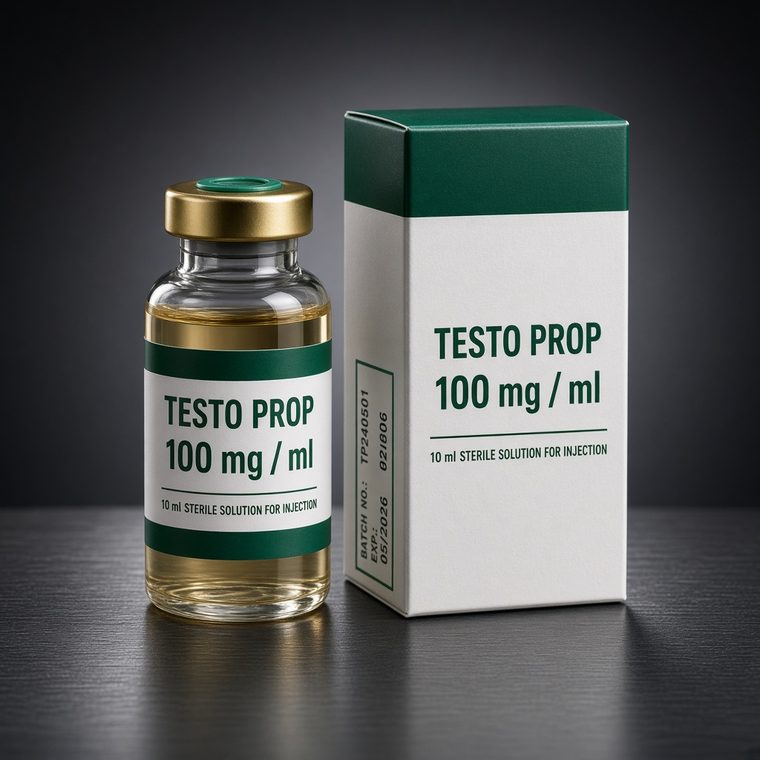
Muscle-Shop.eu delivers pharmaceutical-grade Testosterone Propionate manufactured with refined, ultra-filtered carrier oils and optimized co-solvent ratios designed to minimize post-injection irritation.
HPLC laboratory verification ensures precise 100 mg/ml potency with documented analytical purity exceeding 99.0%. Every batch is certified pyrogen-free and sterile.
Vials include anti-counterfeit holographic verification seals and medical-grade rubber stoppers compatible with repeated multi-dose draws without coring.
Common questions
- Why do athletes experience more post-injection pain (PIP) with Propionate?
- The propionate ester has a shorter carbon chain, which makes it less soluble in base oil alone, requiring higher co-solvent percentages. Rotating injection sites into larger muscles (glutes) and warming the vial gently before injection reduces PIP significantly.
- How often must Testosterone Propionate be injected?
- To maintain stable blood levels and avoid hormonal rollercoaster peaks, it should be administered every other day (EOD) or in daily micro-doses.
- How quickly does it clear the body before a drug test?
- Testosterone Propionate typically clears to baseline urinary metabolite thresholds within approximately 2 to 3 weeks after the final injection.
This page is reference material compiled from published pharmacological literature. It is not medical advice and does not describe a prescription. Discuss any compound with a physician and obtain baseline bloodwork before use.